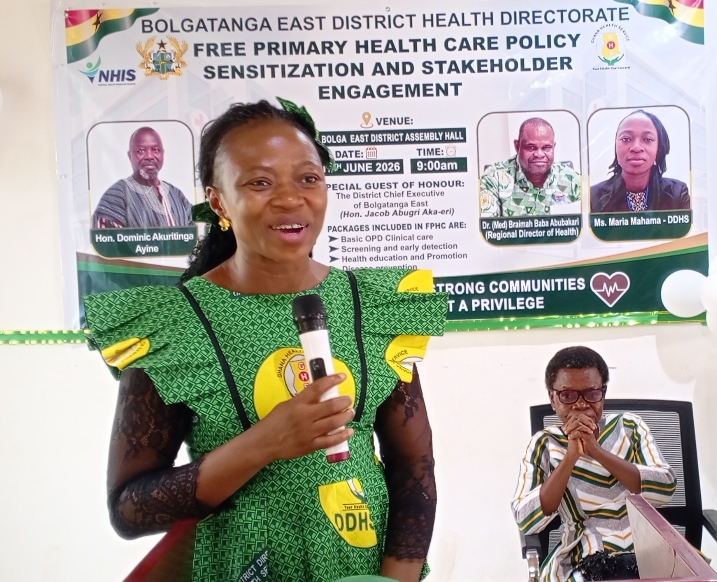
The Bolgatanga East District Director of the Ghana Health Service in the Upper East Region, Ms. Maria Mahama, has said that the Free Primary Health Care (FPHC) policy can only succeed if it is owned by the people.
According to her, although the policy alone is not enough to deliver results, its success depends on the active involvement of key stakeholders.
She stated that for FPHC to work effectively in the district, it must be embraced by everyone, including traditional leaders, assembly members, religious bodies, Civil Society Organizations (CSOs), the community, and all residents of the district.
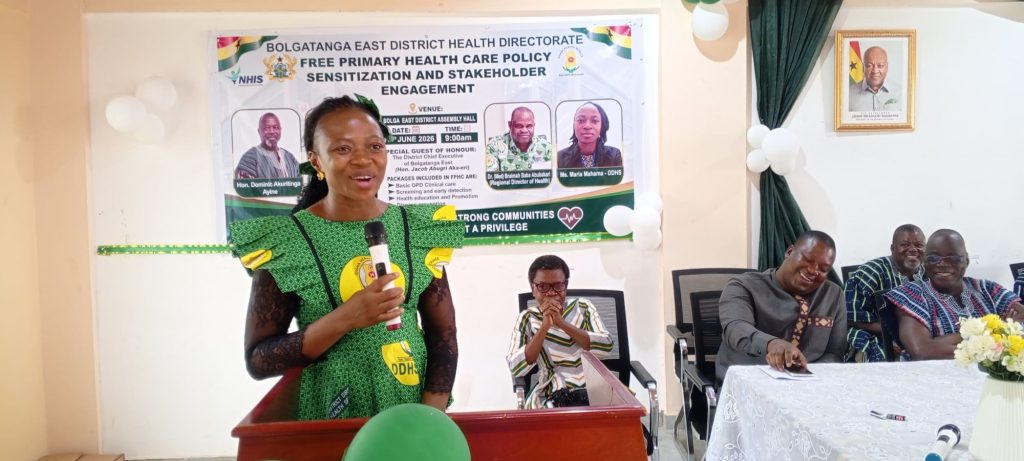
She explained that the stakeholder engagement is not merely meant to inform participants, but to clarify roles and develop a shared plan to ensure that FPHC succeeds in every community from the district capital to the most remote CHPS zones and communities.
Ms. Mahama noted that the stakeholder engagement on the implementation of the FPHC policy in the Bolgatanga East District is particularly important. She emphasized that FPHC is a national policy designed to ensure that all people in the district can access essential primary health services without financial barriers at the point of care.
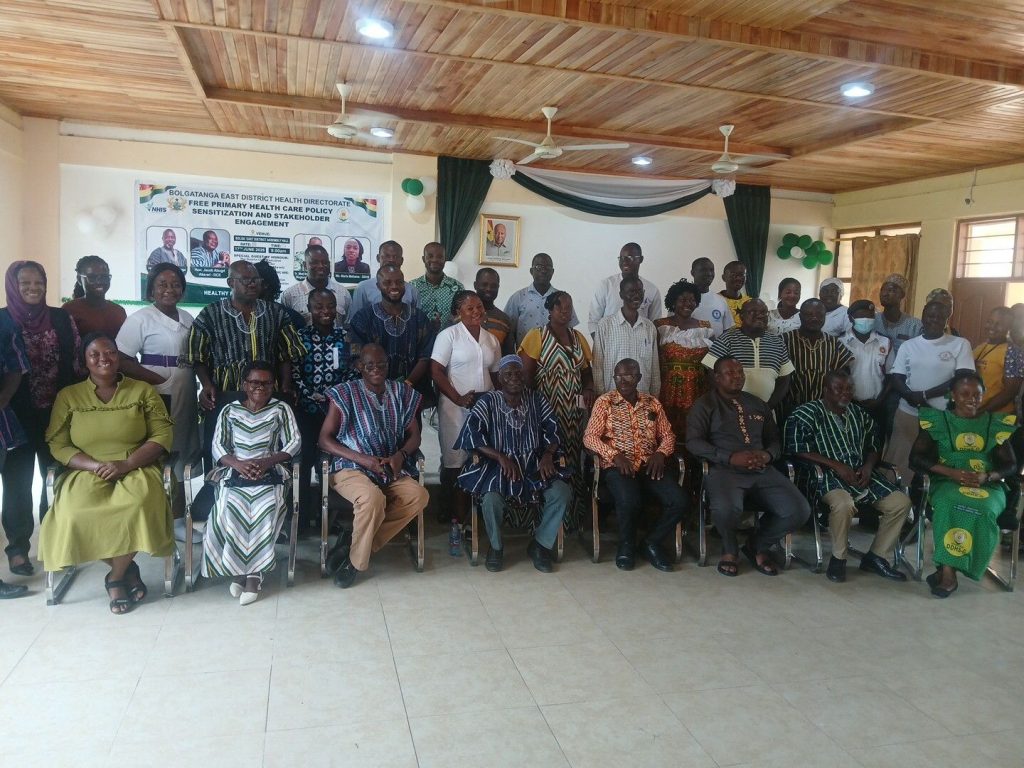
She further stated that the policy supports Ghana’s progress toward Universal Health Coverage (UHC) by improving access to healthcare through preventive and promotive services, early detection of illness, and stronger continuity of care.
Health Facilities and PHC Background.
Ms. Mahama also indicated that the District Health Directorate has a total of 22 health facilities, comprising,16 CHPS facilities, including 10 with compounds and units (CPDs), 3 under construction, and 3 outstanding; 3 Health Centres (HC), with efforts underway to upgrade Katanga and Kumbosco; and 3 private facilities, all staffed by skilled personnel in line with minimum staffing requirements.
She added that the revolution of primary healthcare in Ghana rests on the principle that regardless of whether a nation is rich or poor, every person’s right to access basic health services must be equally guaranteed.
She referenced the 1978 Alma-Ata Declaration, which established Primary Health Care (PHC) as the essential strategy for achieving “Health for All.”She noted that the declaration views health as a fundamental human right and demands accessible, community-based care.
She also highlighted that Ghana introduced the Community-Based Health Planning and Services (CHPS) concept through the Navrongo Community Health and Family Planning Project in 1994, and that CHPS was later launched in 1999 as a national policy community-owned and locally led health services brought closer to people.
Ms. Mahama noted that in 2003, the National Health Insurance Scheme (NHIS) was established to provide financial risk protection for Ghanaians, which she said is foundational to UHC progress.
She further stated that between 2017 and 2024, Ghana developed several PHC strategic frameworks, including community scorecards, networks of practice, and PHC health system structures, all aimed at strengthening the health system.
She acknowledged that Ghana has recorded a marginal increase in health coverage, she said the PHC system still faces challenges such as,low public funding for preventive and promotive services, Ineffective referral systems,Lack of continuity of services over time.
She therefore called on all stakeholders to support efforts to improve health standards in the Bolgatanga East District. she urged everyone present to continue supporting the goal of UHC through FPHC, reminding stakeholders that Health is wealth, and a healthy family is a healthy community.”
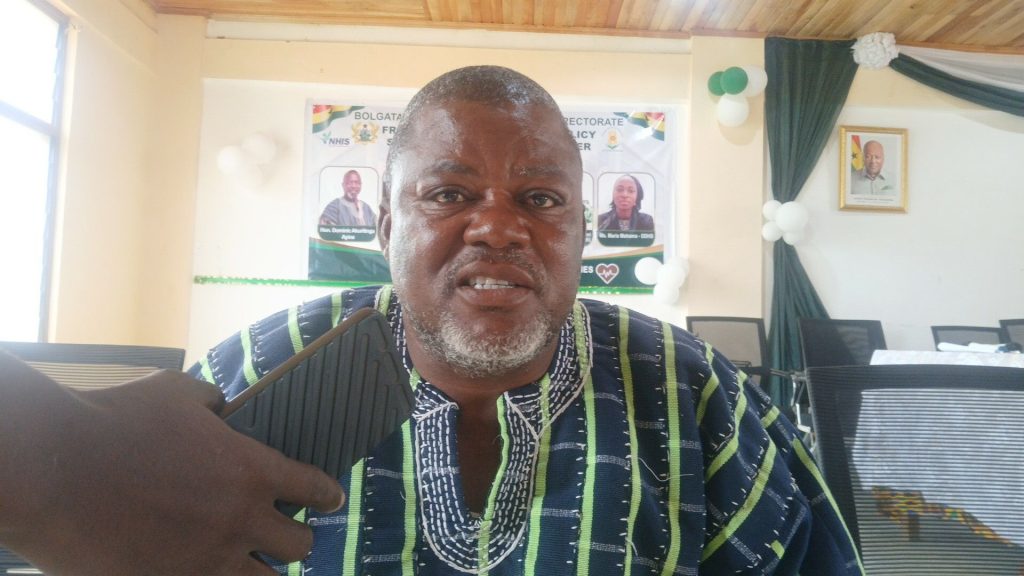
Speaking exclusively to the Bolgatanga Municipal National Health Insurance Manager, Mr. Roland Abane Ayine, highlighted performances in relation to Free Primary Health Care sensitization, including mid-year performance for 2025 and 2026.He said that based on a general comparison, performance in 2026 is better than 2025. Mr. Ayine stated that the office has achieved 63% active membership** in terms of universal health coverage for both the Bolgatanga Municipality and Bolgatanga East District.
He explained that while the current figure represents progress, the target is 80% active membership to further strengthen universal health coverage. He said the office is hopeful that by the end of the year, it will reach the 80% target.
Mr. Ayine added that the NHIS has key responsibilities in supporting FPHC implementation which include Public education and awareness, Monitoring and evaluation, and Membership registration and renewals,all of which he said contribute to effective implementation in the Bolgatanga Municipality and Bolgatanga East District.
He noted that some major challenges affecting their work, Inadequate office space to store consumables, Lack of office space for staff, including motorbikes to access hard-to-reach areas, and Serious network challenges that affect operations.
Source: mywordfmonline.com/Gaspard Adongo Ayuureneeya.